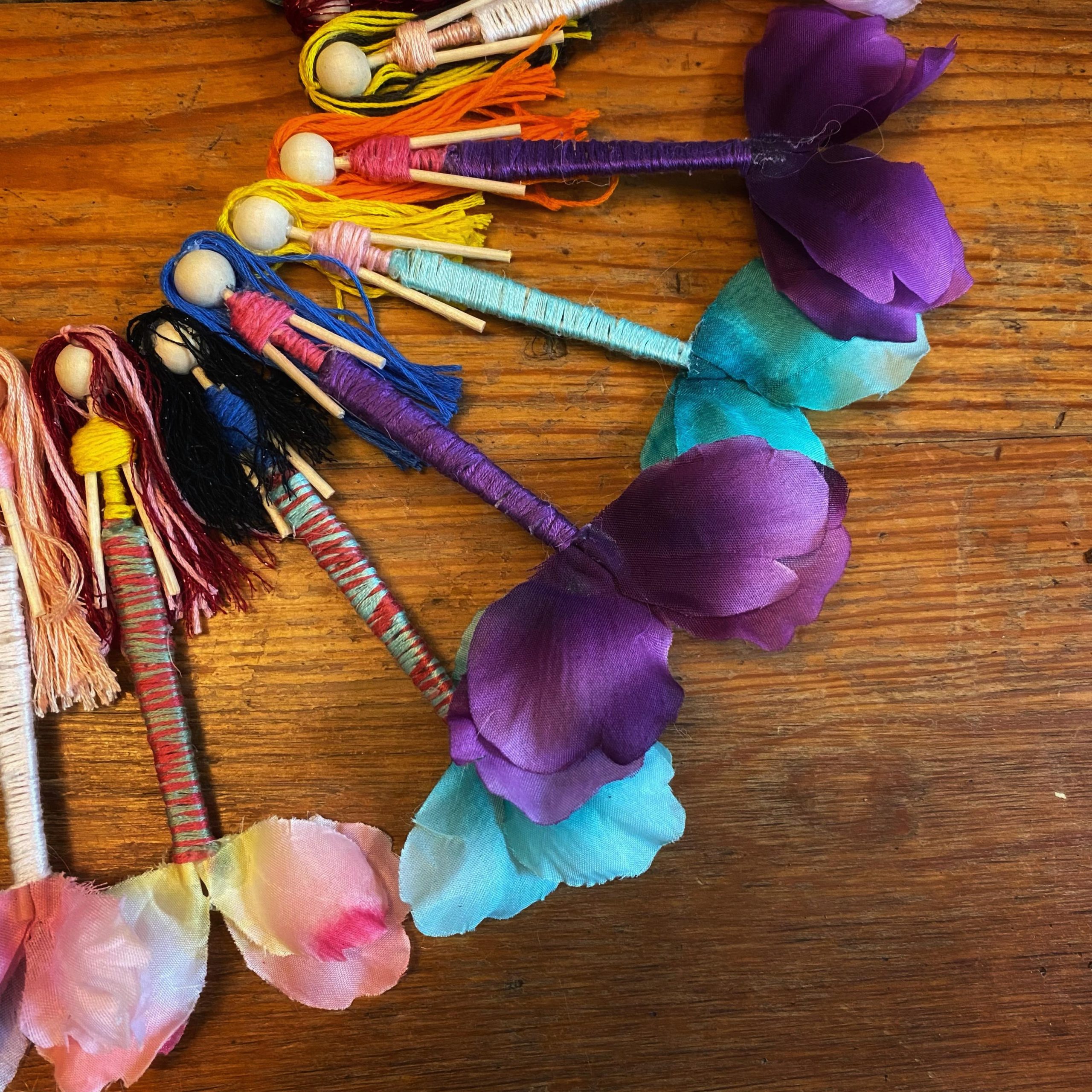
Again, this month\’s post begins with a heartfelt “thank you” to Becca and Jen. It\’s been a tough month. These deliveries made it to you on time because of their help. The one-of-a-kind mermaid worry dolls were made by Becca, and you\’ll find their story below. The beautiful bags, tags, labels, and organization are Jen\’s handiwork. Our \”packing parties\” are getting to be famous, and I don\’t know how I\’d keep everything straight with this many orders without their hands, their hearts, and their organizing talents.
Welcome to the fourth delivery from the Witch’s Garden. Under the Flower Moon, your subscription will contain items related to Beltane, springtime medicine, and the life-giving fire of spring. The meadow is thigh-high, bursting with grasses and wildflowers. Come and wander with us, and bring home the bounty of the Flower Moon.
Reminders:
- Please bring back your cloth bags with the name tag attached, so we know that you returned your bag. Each customer gets two bags for the year – one to pick up full of goodies, and one to return empty so that we can refill it for you next month. The cycle continues until the end of the year, when you can choose whether to keep both bags, one bag, or return them both for us to recycle next year.
- We will also re-use any glass or packing materials you return. Please help us keep costs down by letting us reuse as much as possible.
- If you haven’t yet, please fill out this survey to let me know what you thought of the Pink Moon delivery!
- If you have any trouble with the form, the blog, or the website, please let us know so that we can iron out any kinks.
Password Update
The password for the site is now:
LikeTheFlame
Beltane and The Spring Fire
Our third stop on the Wheel of the Year, Beltane or May Day celebrates the peak of spring and the coming of summer\’s heat. The name is an association with Bel, a Celtic god of fire and the wild. Terri Windling has a lovely and detailed exploration of Beltane if you\’d like to read more.
The Fire of Life
The bonfires of Beltane are symbols for the blaze of life that surrounds us at this time of year – joy, sunshine, the warmth of love, the heat of sex… The Witch in the Garden in spring, her hands in the dirt, making offerings to her seedling plants of manure and compost, water and light and shade, sees inevitably, over and over, the Great Mystery that the brightness of life needs the still dark of earth, the cool movement of air, the refreshment of water. Light and life are inextricably tied to and spring from darkness and death… and that cycle is sacred. Without the balance of elements around us and the spark within us, neither the Witch or the Garden would exist. The Garden feeds and heals and tends the Witch. The Witch feeds and heals and tends the Garden. And the Wheel turns. At Beltane, I feel this most of all.
The Flower Moon
Flowers are everywhere. The fields are full of buttercups, wild chervil, toadflax, and vetches – with countless new wildflowers coming on behind them. Spiderwort and toadflax love the richness of our garden beds, and the rich smells of honeysuckle and early-blooming wild roses add depth to our daily wandering walks.
The Celtic Tree Calendar
A tradition of some Celtic pagan paths, most likely arising in the 1800s but based on the historically ancient ogham writing system, relates a tree species to each lunar month. This month’s lunar correspondence is with the Willow. A symbol of new life and spring fertility, Willow is a perfectly aligned symbol for the season of Beltane.
\”Mer-May\”
In the trickster spirit of spring, a mix of punny warmth and willingness to explore the deeper depths, your mermaid worry doll is a work of art from Becca of LaSheet\’s Treats. Originally a part of Mayan mythology, legend says that the children of Guatemala tell their worries to \”worry dolls\” or \”trouble dolls\” wound from thread and wire.
From Common Hope:
According to legend, Guatemalan children tell their worries to the Worry Dolls, placing them under their pillow when they go to bed at night. By morning the dolls have gifted them with the wisdom and knowledge to eliminate their worries.
The story of the worry doll is a local Mayan legend. The origin of the Muñeca quitapena refers to a Mayan princess named Ixmucane. The princess received a special gift from the sun god that allowed her to solve any problem a human could worry about. The worry doll represents the princess and her wisdom.
The mermaid form is an artistic interpretation of this historic doll, with a flower-petal tail and brushed-thread hair in all the colors of the rainbow. Tell your worries to her and let her take them away, transforming them with the deep power of the sea, the moon and the tides.
Becca writes:


Your Items
So what’s in the box?
 This month’s box includes a “Spring Tonic” tea blend – violet flower and leaf, dead nettle, dandelion heads, cardamom pods; dried willow bark; fresh herbs: apple mint, bee balm (wild bergamot), rue, catmint, southern chervil (some bundles mixed with bur parsley and/or cranesbill); a potted chocolate mint; and flowers: honeysuckle, fleabane, and spiderwort. A great deal of this bag is fresh. The mailers will receive alternate items – bath bombs made with violet epsom salts, rose petal, and honeysuckle; dried flowers; and natural yarn from our angora bunnies.
“Spring Tonic” Blend – violet flower and leaf, dead nettle, dandelion, cardamom. This blend will clear and cleanse, magickally or literally. Scatter on your altar or use as a tea during a springtime ritual. Cardamom is feminine, corresponding with the element of Water and with Venus. You\’ve seen violet, dead nettle, and dandelion already this year, and you can find more about them in the Budding Moon blog post.
Cleavers – As you\’ve seen with lots of spring forage herbs, cleavers is a cooling diuretic, excellent for eczema or rashes, and even used in weight loss blends because of its \”cleansing and clearing\” properties. Lovely in salves, tinctures, and oils, it makes an excellent poultice for wounds or rashes, especially mixed with some of your wild bergamot. It balances the lymphatic system, sticks stubbornly to everyone and everything, and is also called \”bedstraw\” because it was historically used to stuff mattresses. It can help with gout, urinary or prostate problems, and even some forms of arthritis (Healthy Green Savvy). Binding, connection, and spells that need either rest and renewal before action or a sense of \”stick-to-it-iveness\” are perfect workings for cleavers (Hagetisse).
Chocolate Mint – a beautiful mint with red-brown edges and a deep green core, chocolate mint is known for reducing flatulence, calming nausea, improving the breath, and energizing the body. Correspondences include abundance, fertility, and communication, according to The Infinite Succulent. Your potted baby can live in a window sill or be planted outdoors, either in a pot or in the ground. Chocolate mint spreads wildly and can overcome other growing things, so please plant in an appropriate location and maintain by mowing, weed eating, or pulling runners that spread outside the area you\’ve defined for them.
Dried Willow Bark – This is the inner bark of our old Black Willow that holds court over the pond, harvested from branches downed in the early spring storms. Harvesting the inner bark is pleasant, satisfying, and meditative – it pulls in wide strands or strips from the outer bark once it\’s pried up, opening like a book. Willow is \”nature\’s aspirin\”, a potent anti-inflammatory, tonic, and pain reliever. According to Green Man Meadows, she\’s also a feminine energy, one who helps aid in menstruation and childbirth, one who can and does stand at the doorways of becoming. Willow wands are often used in Wiccan circles to draw down the moon. Use your bark as an incense during meditation, as an addition to a ritual bath (it\’s so good for an itchy scalp or rough skin), or in a tea or tincture.
Bee Balm/Wild Bergamot – Boiling your bergamot and breathing the steam is an excellent remedy for a sore throat or chest cold. An herbal tea that includes this leaf can help with flatulence, bloat, and menstruation, as well as insomnia and nausea. The scent is also used as aromatherapy in essential oils. Like willow and cardamom, her correspondences are with feminine magick and the moon. Unlike willow and cardamom, she\’s an intellectual air spirit, associated with air rather than water. You can learn more by reading this Sedona Aromatics article or exploring Monarda: Folklore, Spiritual and Magickal Uses on MagickalSpot.
Rue – Rue, the \”mother of all herbs\”, walks between the worlds. Sacred to goddesses Diana and Aradia, the herb is also considered masculine, associated with the element of fire. Strongly protective, used in the breaking of hexes and as protection against the \”evil eye\”, rue can be added to a spell bag or strewn across a threshold. Just remember to handle carefully. Rue should not be used internally except while working with a trained herbalist. A powerful, protective magickal herb, used historically to deter pests and rodents, rue can be taken internally and has historically been used in small amounts as a culinary herb in Mediterranean cuisines. However, it can cause a quick anaphylactic reaction in those allergic, so many herbalists these days don\’t recommend using it internally at all, and those who are pregnant or nursing should avoid even skin contact, as the plant is an abortifacient (Mountain Rose Herbs). It can also give a mild rash (contact dermatitis) to some. If you find this is an issue for you, use gloves or wash your hands and arms after handling.
Catmint – Like some of the other springtime feminine herbs in your bag, catmint is a lovely ingredient in teas for problems with menstruation or digestive upset, including nausea, gas, and indigestion. The same properties that help with these issues also make it useful in blends for colds and chest congestion (Eat the Planet). Catnip and catmint are not the same plant, though you see some confusion on witchy blogs. Both are closely related mints, with many similar aspects, but catmint won\’t stimulate your cats the way catnip will. They\’ll likely show some curiosity and interest in the scent, but not to the level of catnip crazies. She\’s also associated with Venus, water, and the moon – are you sensing a theme?
Apple Mint – This sweet, hairy mint has a slight smell of “Granny Smith” apple about it. A big, cheery plant that dwarfs many of its early spring companion, this mint is delicious fresh or dried, in everything from teas to sweets to salad. This mint shines wherever you put it, working well with any pairings without stealing the show. We can learn from that. Like catmint, this is a gentle and aromatic mint that soothes rather than stimulates the stomach. Think prosperity, cleansing, healing, and soothing for correspondences and magickal workings (Jasmeine Moonsong).
Southern Chervil – Since this wild native chervil relative is still young, some bundles also contain bur parsley or Carolina cranesbill to round them out. Use this wild carrot relative on your altar with the spiderwort and fleabane, or in other ornamental decorative locations. These plants are technically edible but closely similar to poisonous lookalikes, so please use them for magickal are decorative purposes. Classic garden chervil connects us to our higher selves and helps in communication with loved ones that have passed on. Other Queen Anne\’s lace/carrot relatives are tied magically to fecundity, fertility, and lust. This wild native chervil, also known as Tainteurier\’s Chervil, is a perfect local, native alternative fthat grows abundantly and joyfully in this part of the world, and can correspond for all these magickal purposes.
Honeysuckle – I love Unruly Gardening\’s \”Uses for Honeysuckle Flowers\”. And that\’s just the flower! The whole plant is useful in a range of herbal, magickal, and wonderfully crafty ways. The vine makes a lovely basket with a beautiful range of natural color options. \”Sweeten\” any spell with honeysuckle… prosperity, connection, love, luck. Enhance psychic and dream work, gardening and plenty and fertility spells with honeysuckle flower.
Fleabane – Philadelphia fleabane, a native forage flower, was used by multiple native american groups for menstrual pain, eye issues, and skin problems (USDA). It\’s also an abortifacient, so those pregnant should not consume. Fleabane and spiderwort together are a lovely, healing spring blend that can cleanse and clear obstacles. Just as we did at Daughters of the Moon, set them on your altar to celebrate spring, and ask the rains and breezes of the spring wilds to clear your way.
Spiderwort – From Edible Wild Foods:
Spiderwort had many uses in First Nation’s culture as food and medicine. The seeds are edible when roasted and ground into a powder (although they are somewhat bitter to taste). Leaves can be made into a tea or tossed into salads, soups, etc. The root can be collected all year round. The flowers can be tossed on top of a salad and eaten. (Dried, powdered flowers were once used as a snuff for nosebleeds.)
Externally, this plant can be used as a poultice to help heal wounds and hemorrhoids. Internally the leaves and roots are a valuable alternative medicine used by medical herbalists for their patients as an antidiarrheal, analgesic, anthelmintic, antiperiodic, astringent, diaphoretic, emetic, emmenagogue, expectorant, sedative, tonic, vermifuge, and vulnerary. Also, drinking spiderwort tea is supposed to be a good for increasing breast milk (Galactagogue).
Here\’s what\’s in the mailers:
- First image, from top to bottom:
- Bath bombs: Violet epsom salts made from our violet leaf and flower,baking soda, citric acid, corn starch, dried honeysuckle and rose petal, black willow bark decoction, chickweed oil (olive oil carrier oil).
- Wire-wrapped stone pendant: These were gifted by one of our members and are a beautiful example of the flow of magick in the world. Each is different. If you have any trouble identifying your stone, post a pic in the Facebook group and we\’ll help you identify it.
- Mermaid worry doll, as above for local deliveries.
- Second image, clockwise from top left:
- Rose and honeysuckle flower blend: Scatter on your altar, float in a tub, scatter in your sheets for a hint of romance, or even use in a tea blend.
- \”Spring Tonic\” blend, as above for local deliveries.
- Black willow bark, dried, as above for local deliveries.
- Plantain, dried, as above for local deliveries. Local was fresh – yours has been dried and will preserve. Use as you would fresh or in salves or balms.
- Angora yarn, harvested on Beltane from our angora bunnies. This yarn is handspun and blended with no more than 10% wool for strength.


Using Your Items
The items in your box are yours to do with as you please. I don’t put together “spell kits” or provide rituals for you – you have your own path to walk, and I have mine. Instead I try to provide you with items to use in your own practice, sharing some of my own plans and ideas as inspiration. Legalese, because it’s an important thing sometimes: By using these items, you acknowledge that YOU are responsible for any and all outcomes, including any allergic reactions, and not me or The Witch’s Garden. Know thyself, witch.
A few suggestions for using your items:
Create a self-care or ritual experience. Set flowers and candles around a bath, brew a gentle mint and honeysuckle flower tea, and settle in, with your worry doll beside the tub. Name her if you like. Once you\’re feeling clean and settled, find those worries that are most problematic to you and tell her about them. Out loud, and completely, if you can. When you\’re finished with your bath, bring your flowers, worry doll, and the remains of your tea to your altar. Feel free to add herbs from this bag to your doll to meet your intention. Leave her on your altar until bedtime. Tuck her in under your pillow, settle in with a gentle night time routine (tea, journaling, a book/audiobook, a meditation). Give your worries completely to your doll, and drift off to sleep.
Set up a spring alter with your Flower Moon items. For those of you who know or went to the Daughters of the Moon retreat this year, the Spiderwort and Fleabane were the flowers on the Goddess altar in the main hall; the Fleabane was used as a blessing during Leela\’s puja.
Conduct a ritual for yourself or your loved one(s). Craft a small container out of the honeysuckle vine, and fill it with herbs from your bag that match your intent. Leave the container on your altar until the flowers have faded. If you\’re calling something to you, \”plant\” your basket and its contents in the earth near your home by burying it in soil or a flower bed or pot. If you\’re banishing, releasing, or sending something away, set your basket in running water and watch it float away or sink – both serve the purpose of giving that to be removed to the water.
Happy Beltane, beloveds. May the height of spring warmth quicken you. Enjoy the morning dew, the heat of the sun, and the smell of flowers everywhere. Blessed Be.
-Elm